- Product KPI
Northstar Metric for The StarHub App

Product teams—whether product managers, designers, or developers—are driven to build digital experiences that attract, engage, and retain customers. Yet despite their dedication, many teams still struggle with a lack of clarity, alignment, and accountability, making it difficult to consistently achieve their goals.
That was exactly the challenge we faced at StarHub—and where Amplitude’s North Star Framework became invaluable.
At its core, the North Star Metric is a focused, outcome-driven measure that reflects the value users gain from a product and how that value drives long-term business success. Unlike surface-level metrics like daily active users, it must represent real customer value, be within the control of product teams, and serve as a leading indicator of growth.
The real power of the North Star Framework lies in its ability to break teams out of siloed thinking. It unifies the language of the customer, the product, and the business—creating clarity and alignment across functions.
Surrounding this is the broader North Star Framework, anchored by 3–5 key input metrics that capture essential user behaviors. This structure helps align teams around a shared goal, ensuring daily work contributes to strategic impact. A great example is how Amplitude refined its own metric from “weekly querying users” to “weekly learning users,” reinforcing its mission to empower smarter, data-driven product decisions.
Having worked with the North Star Metric (NSM) at previous companies, I proposed introducing the framework to help our digital teams align more effectively, increase transparency, and rally around a shared goal. I initiated a three-month project and brought together key stakeholders—including product managers, digital product owners, and designers—while partnering with our research lead to plan, facilitate, and execute a series of workshops that ultimately defined our North Star Metric.
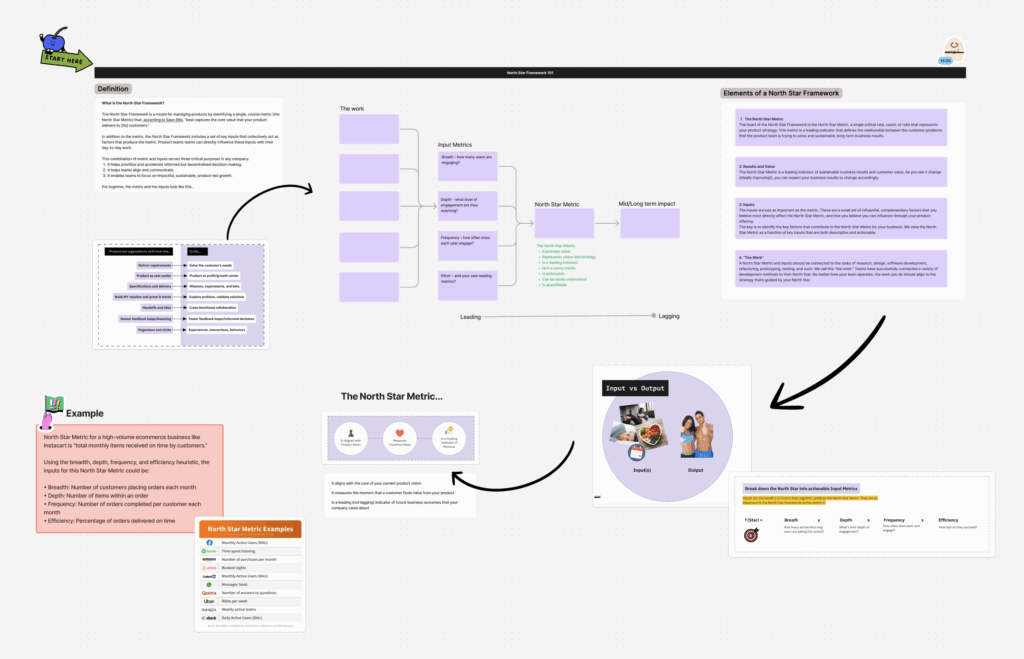
Workshop #1: Definitions and framework
For the initial kickoff workshop, our goal was to build a strong foundational understanding of Amplitude’s North Star Framework among all participants. We began by walking through the core principles of the framework—explaining its purpose, structure, and the value of aligning teams around a single, outcome-oriented metric. To bring the concept to life, we shared real-world examples of North Star Metrics from various companies, illustrating how they reflect true customer value and serve as leading indicators of growth.
We then guided participants through each step of the framework, including identifying potential input metrics and understanding how they connect to the overarching North Star. This interactive session encouraged open discussion and gave everyone—from product managers to designers—a shared language and starting point. By the end of the workshop, participants were aligned on the framework’s intent and ready to collaborate on defining a North Star Metric tailored to our own products and users.
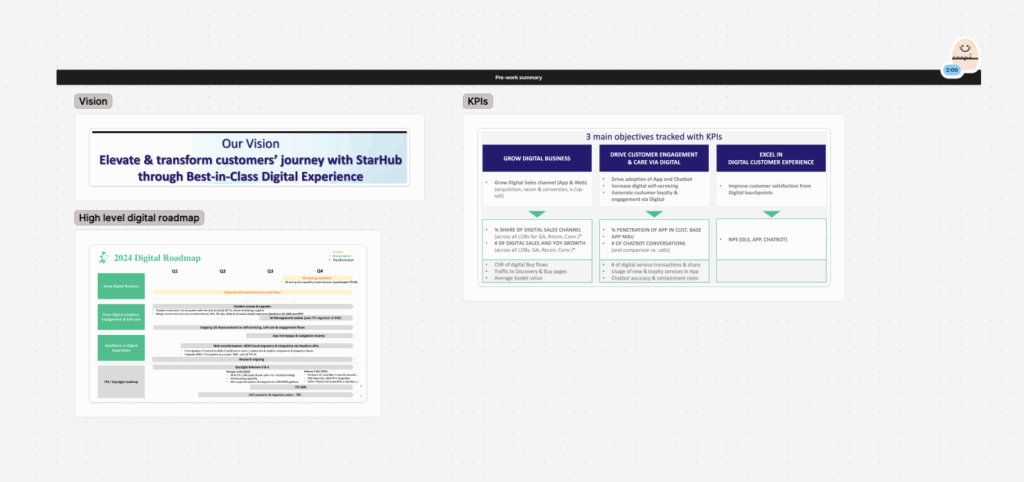
Workshop #2: Vision and KPIs
In the second workshop, we shifted focus toward defining our long-term direction and aligning it with measurable outcomes. We began by co-creating a clear and inspiring vision statement to guide our product efforts and ensure alignment across teams. With that vision in place, we reviewed the 2025–2026 digital roadmap, identifying key strategic initiatives and priorities already in motion.
Building on this foundation, we started mapping out a comprehensive list of KPIs specifically tied to the StarHub App. These KPIs aimed to reflect both customer value and business impact, laying the groundwork for selecting meaningful input metrics that would ultimately support our North Star Metric. This session was highly collaborative and helped bridge strategy with execution, setting the stage for focused decision-making in upcoming phases.
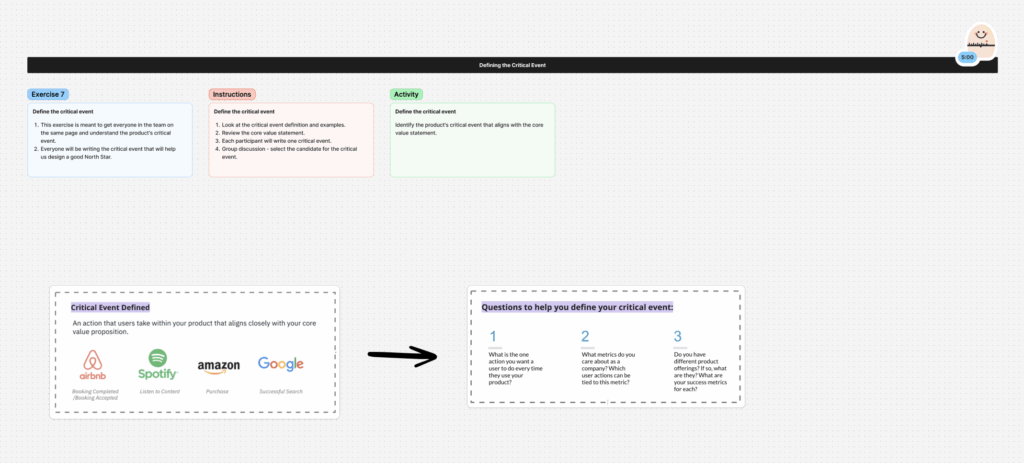
Workshop #3: Critical Event & Understanding Monitization
In our third workshop, we concentrated on refining the core elements that would directly inform our North Star Metric. The primary focus was identifying the critical event—the key user action that best represents the moment when value is delivered in the StarHub App experience. This step was essential in grounding our metric in real user behavior.
We then explored how this critical event connects to monetization and revenue, discussing how different engagement patterns contribute to long-term business outcomes. By mapping the relationship between user actions and revenue drivers, we were able to narrow in on metrics that not only reflect customer value but also align closely with StarHub’s growth objectives. This session brought product, design, and business stakeholders together to ensure both customer impact and commercial viability were equally considered.
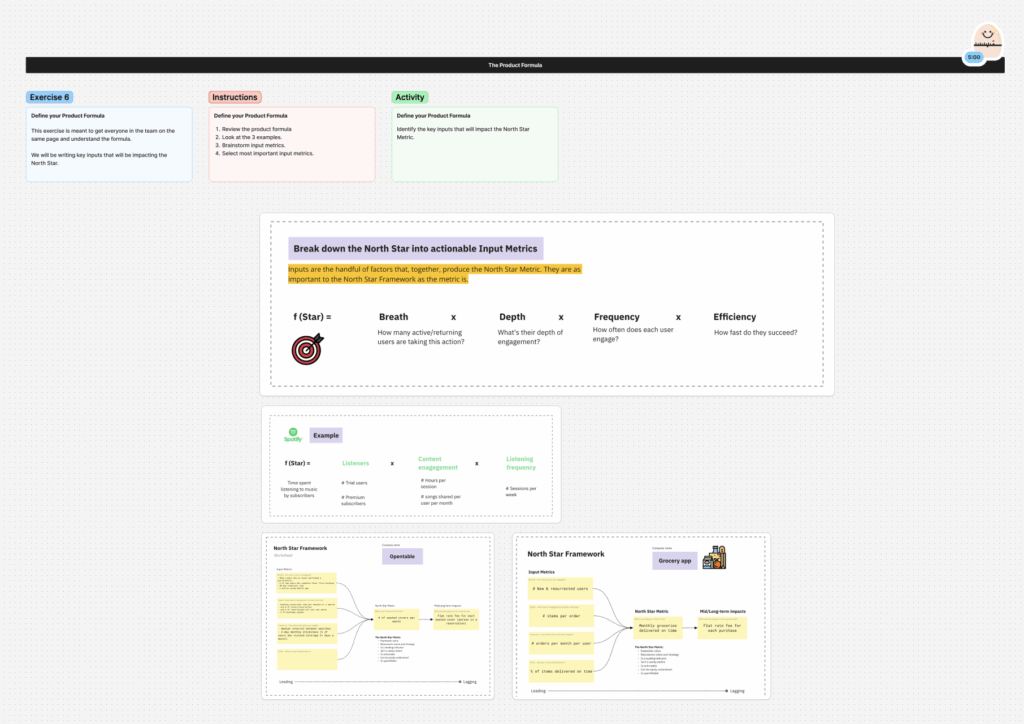
Workshop #4: The Product Formula
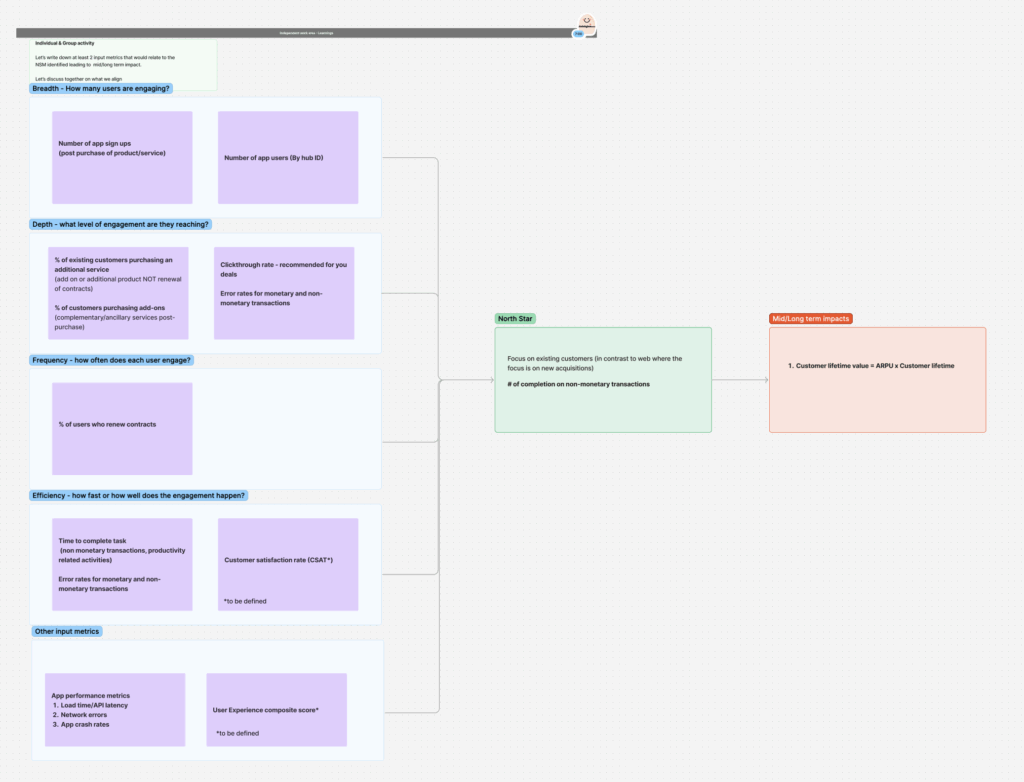
In our fourth workshop, we focused on shaping our product formula—a clear expression of how customer value is created through the StarHub App—and identifying the input metrics that drive our North Star Metric. The product formula helped us articulate the relationship between user actions, engagement, and outcomes, providing a shared understanding of what success looks like.
From there, we collaboratively defined 3–5 key input metrics that reflect high-impact user behaviors aligned with our critical event and revenue goals. These input metrics were chosen based on their ability to be influenced by our teams and their potential to drive movement on the North Star Metric. This session was instrumental in aligning teams around measurable levers they could own and optimize, bringing us one step closer to operationalizing the framework.
Final Session: Putting it all together
In the final workshop, we brought all the pieces together. With our product formula and input metrics clearly defined, we evaluated how each metric contributed to customer value and business outcomes. Through a collaborative review, we prioritized the most meaningful signals and aligned on how they connected to our strategic goals.
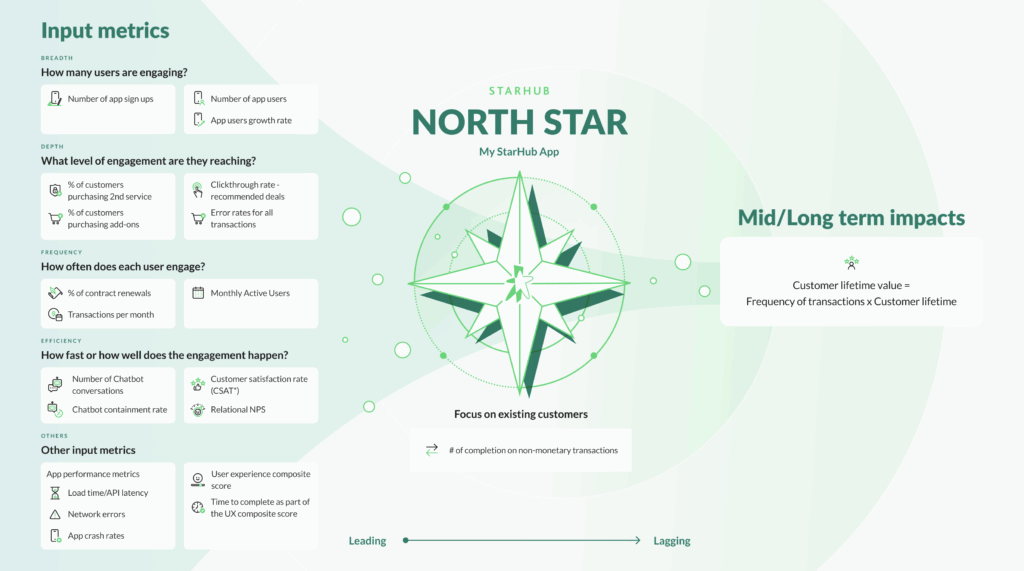
By the end of the session, we synthesized our work into a single, outcome-focused North Star Metric—one that reflected the core value delivered by the StarHub App and could guide product decisions moving forward. While we recognized that this initial NSM may evolve over time, it served as a critical first step in unifying teams around a common measure of success.
Outcome
The North Star Metric initiative and accompanying workshops led to a strong sense of alignment across teams, creating a shared understanding of what customer value truly looks like. Through a collaborative, cross-functional process, we identified key input metrics and behaviors that drive our North Star, giving each team a clear focus for their efforts. The workshops also surfaced gaps in communication and priorities, which we addressed by establishing a common language across product, design, and business functions.
As a result, teams should begin making more strategic, outcome-driven decisions, and the North Star Metric will become a central tool for guiding roadmaps, measuring progress, and reinforcing accountability across the organization.
The image above represents the finalized North Star Metric infographic, designed to be shared organization-wide for alignment and visibility.
Next Steps
The next steps involve operationalizing the North Star Metric to ensure it remains a living, actionable part of our product development process. This includes:
Embedding the Metric in Team Rituals – Incorporate the North Star and its input metrics into sprint planning, retrospectives, and product reviews to maintain ongoing focus and alignment.
Ownership & Accountability – Assign clear ownership of each input metric to relevant teams, ensuring responsibility for tracking, reporting, and improving these drivers.
Continuous Feedback & Refinement – Set regular check-ins (e.g., quarterly) to review the relevance of the North Star Metric and input metrics, and adjust based on customer feedback, product changes, or business shifts.
Internal Education & Onboarding – Create onboarding materials and short training sessions to ensure new team members understand the framework and how it connects to their day-to-day work.
Dashboards & Visibility – TBD
By taking these steps, we can ensure the North Star Metric remains a strategic compass that drives focus, fosters collaboration, and helps deliver meaningful outcomes for both the business and our customers.